Last year, Marvel Studios announced that “Avengers: Endgame” would get a theatrical re-release ahead of the next superhero team-up movie, December’s “Avengers: Doomsday.” Turns out, there’s more to the “Endgame” than previously advertised.
During the Walt Disney Studios presentation at CinemaCon on Thursday, directors Joe and Anthony Russo announced that the Sept. 25 release will include brand-new footage from the already 3-hour-long movie. Plus, both “Endgame” and “Doomsday,” in theaters Dec. 18, will also be presented in “Infinity Vision,” a new certification for premium large format theaters, which is touted as delivering “the biggest, brightest and most immersive cinematic experiences” for moviegoers.
Parents and campaign groups seeking tighter restrictions on social media have welcomed a Los Angeles jury handing down an unprecedented win for a young woman who sued Meta and YouTube over her childhood addiction to social media.
Jurors found that Meta, which owns Instagram, Facebook and WhatsApp, and Google, owner of YouTube, intentionally built addictive social media platforms that harmed the 20-year old’s mental health.
The woman, known as Kaley, was awarded $6m (£4.5m) in damages, a result likely to have implications for hundreds of similar cases now winding their way through US courts.
Meta and Google said they disagreed with the verdict and intended to appeal
Meta said: “Teen mental health is profoundly complex and cannot be linked to a single app.
“We will continue to defend ourselves vigorously as every case is different, and we remain confident in our record of protecting teens online.”
A spokesperson for Google said: “This case misunderstands YouTube, which is a responsibly built streaming platform, not a social media site.”
“How many more children are going to be harmed and potentially die from these platforms?” she asked.
“It’s been proved it’s not safe – and social media companies need to fix it.”
‘Malice, oppression or fraud’
Jurors found that Kaley should receive $3m in compensatory damages and an additional $3m punitive damages, because they determined Meta and Google “acted with malice, oppression, or fraud” in the way the companies operated their platforms.
Meta will be expected to shoulder 70% of Kaley’s damages award, with Google the remaining 30%.
Parents of other children, who are not part of Kaley’s lawsuit but claim they also were harmed by social media, were outside the courthouse on Wednesday, as they had been many days throughout the five-week trial.
When the verdict came through, parents like Amy Neville were seen celebrating, and hugging other parents and supporters who had been waiting for a decision.
Mike Proulx, a research director for advisory firm Forrester, said the back-to-back verdicts underline a “breaking point” between social media companies and the public.
In recent months, countries such as Australia have imposed restrictions for children to stop or limit their use of social media. The UK is currently running a pilot programme to see how a ban of social media for people aged under 16 may work.
“Negative sentiment toward social media has been building for years, and now it’s finally boiled over,” Proulx said.
Reacting to the verdict, Prime Minister Sir Keir Starmer said the status quo was “not good enough” and more needed to be done to protect children.
Highlighting the government’s consultation asking whether to ban social media for under-16s, he said: “It’s not if things are going to change, things are going to change.
The question is, how much and what are we going to do?”
Meanwhile, the Duke and Duchess of Sussex, who have campaigned at length about the harms of social media, called the verdict a “reckoning”.
“Let this be the change – where our children’s safety is finally prioritised above profit.”
British online safety campaigner Ian Russell, whose 14-year-old daughter Molly took her own life in 2017 after consuming harmful content online, told the BBC’s Newsnight programme: “There is a big hope that this is a big moment and tech will… [need] to change, but only if the governments do something about it.”
Parents and family members of victims were at the court in LA to hear the verdict
During his appearance before the juryin February, Mark Zuckerberg, Meta’s chairman and chief executive, relied on his company’s longstanding policy of not allowing users under the age of 13 on any of its platforms.
When presented with internal research and documents showing that Meta knew young children were, in fact, using its platforms, Zuckerberg said he “always wished” for faster progress to identify users under 13. He insisted the company had reached the “right place over time”.
While Google, as the owner of video-sharing site YouTube, was also a defendant in the case, most of the trial proceedings focused on Instagram and Meta.
Snap and TikTok were also initially defendants, but both companies reached undisclosed settlements with Kaley prior to trial.
Trump called Tarlov “one of the Least Attractive and Talented People on all of Television” in a fiery Truth Social post written as he was watching Fox News on Air Force One Thursday evening.
“Her voice is so grating and terrible, I had to ‘turn her off!’ Her Democrat soundbites are FAKE. She makes up ‘Poll Numbers,’ and nobody challenges her, because she is so boring,” the president said.
Tarlov, a former strategist and pollster for the Democratic Party, bashed Trump’s popularity during a round-table discussion with her co-hosts on The Five Thursday evening.
“He has a 35 percent approval rating in most polls,” Tarlov said, later adding, “No Americans wanted the tariffs, they didn’t want the war in Iran, and they don’t want the ballroom.”
President Donald Trump wrote taht Fox News host Jessica Tarlov’s ‘Democrat soundbites are FAKE. She makes up ‘Poll Numbers’’ (Getty Images)
A recent The Economist/YouGov poll found that just 38 percent of Americans approve of the way Trump is handling his job as president, while 56 percent disapprove.
Most Americans don’t back the war that Trump and Israel waged against Iran, according to the poll. Just 32 percent of respondents said they support the Iran war, while 55 percent said they opposed it.
Most Americans also opposed Trump’s $400 million White House ballroom in a poll released last October, when the project was originally estimated to cost $300 million.
A total of 56 percent of Americans opposed the ballroom and just 28 percent supported it, according to a poll conducted by The Washington Post, ABC News and Ipsos.
Jessica Tarlov used the publicity to promote her new book, ‘I Disagree’, on social media (Getty Images)
Trump insisted in his Thursday Truth Social post that he has “among the best Poll Numbers I have ever had, and why shouldn’t I, ALL THE COUNTRY DOES IS WIN.”
Tarlov denied that the polling results she mentioned were fake and used the attention the president provided to promote her new book, which will be released in September.
“Guess I’ll take this opportunity to mention that my numbers are far from fake – Trump really is that unpopular. And you can pre order my book I Disagree as of today!!” she wrote on X, along with an image of the president’s rant.
Trump is known for attacking journalists, and mostly women reporters, calling them “stupid”, “incapable”, and referring to one as “piggy”.
In November, Trump told Bloomberg White House correspondent Catherine Lucey, “quiet, piggy,” after she asked about the government files related to the late convicted sex offender Jeffrey Epstein. The Trump administration has faced fierce backlash over its handling of the files.
Trump also attacked former MAGA faithfuls including Megyn Kelly in his rant (AFP via Getty Images)
Trump also attacked former MAGA faithfuls Megyn Kelly, Tucker Carlson and Candace Owens in his Thursday posts on Truth Social.
“I hear Megyn Kelly, Tucker Carlson, and Candace Owens are dying fast. Their numbers are terrible. Nobody believes them anymore. They were FAKE MAGA, and now they’ve been exposed!” he said, without providing any evidence to back up his claims.
Owens responded to one of Trump’s posts, calling it a “meltdown.”
“Looks like he may have accidentally heard the truth?” she wrote on X.
“They think it is wonderful for Iran, the Number One State Sponsor of Terror, to have a Nuclear Weapon — Because they have one thing in common, Low IQs,” Trump wrote on Truth Social.
Here’s a clean, SEO-friendly article based on your post:
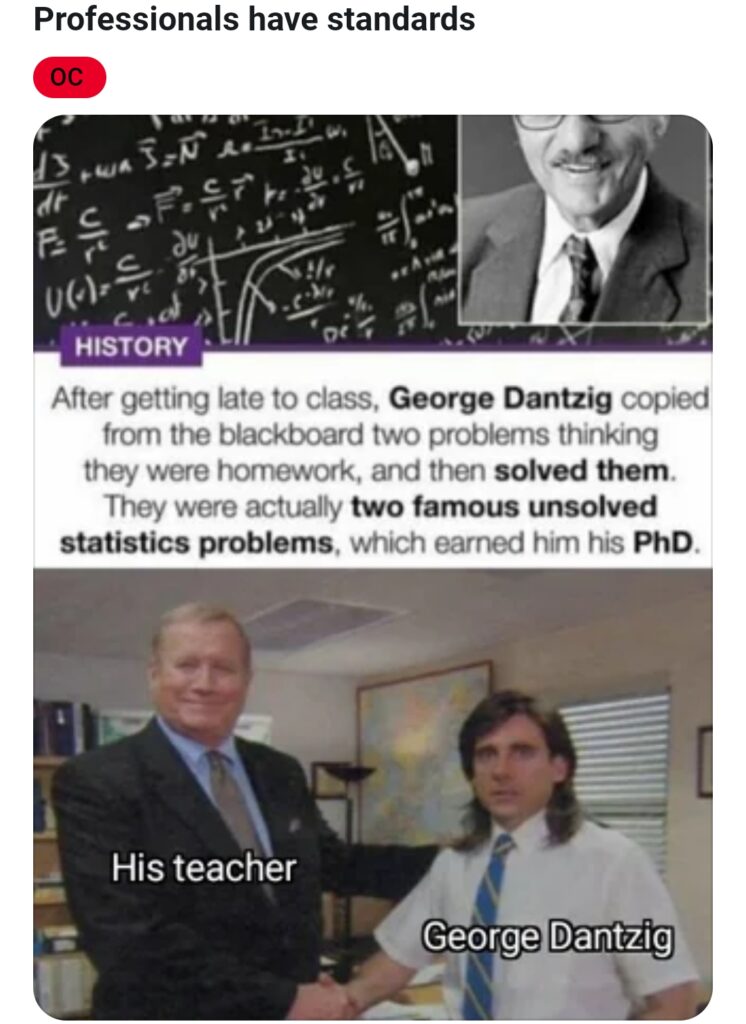
The Inspiring Story of George Dantzig: When “Homework” Changed History
Sometimes, success comes from unexpected moments—and the story of George Dantzig is a perfect example. What seemed like a simple classroom misunderstanding turned into one of the most inspiring moments in academic history.
A Late Arrival That Changed Everything
One day, George Dantzig arrived late to his statistics class. As he walked in, he noticed two problems written on the blackboard. Assuming they were homework assignments, he copied them down without giving it much thought.
To him, they were just another set of exercises to complete.
The “Impossible” Problems
What Dantzig didn’t know was that those problems were not ordinary homework. They were actually two famous unsolved problems in the field of statistics—questions that had puzzled experts for years.
Without realizing their difficulty, Dantzig approached them like any other assignment. He worked through them patiently and eventually found solutions.
A Shocking Discovery
After some time, Dantzig submitted his answers. His professor was stunned. The problems he had solved were believed to be unsolvable at the time.
This accidental breakthrough became a defining moment in his academic career and eventually contributed to him earning his PhD.
The Power of Mindset
What makes this story so powerful is not just the achievement—but the mindset behind it.
Dantzig didn’t know the problems were “impossible.” Because of that, he didn’t limit himself. He simply focused on solving them, free from doubt or fear.
This highlights an important lesson: Sometimes, believing something is possible is the biggest advantage you can have.
Why This Story Still Matters Today
In today’s world, many people hold back because they think something is too difficult or beyond their ability. Dantzig’s story reminds us that:
Limits are often mental
Confidence can outperform experience
Great breakthroughs can come from simple प्रयास (effort)
Conclusion
The story of George Dantzig is more than just a historical anecdote—it’s a reminder that greatness can come from ordinary moments. A late class, a misunderstood assignment, and a determined mindset led to solving problems that others thought were impossible.
Next time you face a difficult challenge, remember: It might just be “homework” waiting to be solved.